
그림자- 서 있기, 145x180cm, 한지에 채색, 2020

침묵, 145x180cm, 한지에 채색, 2020

바다, 145x180cm, 한지에 채색, 2020

Grave 2020, 120x162cm, 한지에 채색, 2020

붉은 땅, 145x180cm, 한지에 채색, 2020

돌팔매, 130x193cm, 한지에 채색, 2020
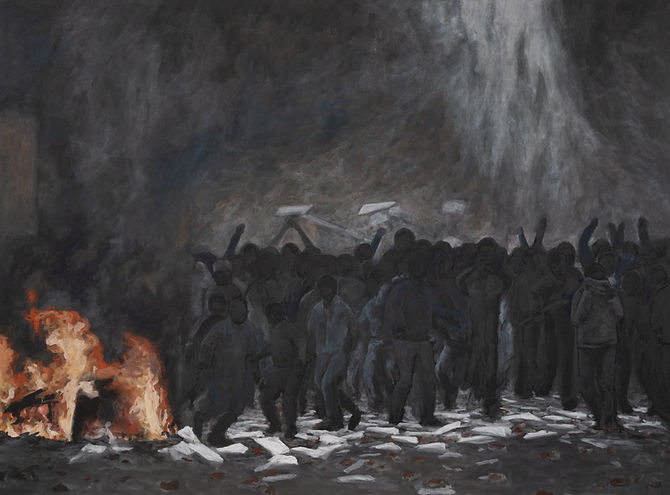
거리에서, 120x162cm, 한지에 채색, 2020
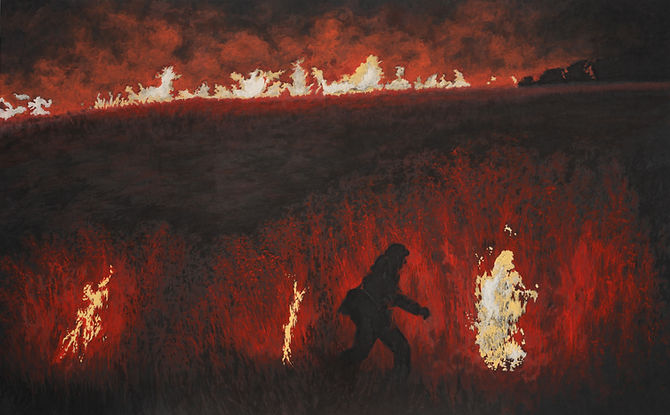
맞불, 112x180cm, 한지에 채색, 2020

바람, 162x120cm, 한지에 채색, 2020

안개, 97x130cm, 한지에 채색, 2020

타격, 91x117cm, 한지에 채색, 2020

꽃, 73x117cm, 한지에 채색, 2020

절반의 밤, 97x130cm, 한지에 채색, 2020

열차, 80x117cm, 한지에 채색, 2020

아무것도 아닌 것, 73x91cm, 한지에 채색, 2020

화염, 53x41cm, 한지에 채색 , 2020

검은 옷, 53x41cm, 한지에 채색, 2020

먼지, 53x141cm, 한지에 채색, 2020

누구도 아닌-7년, 53x41cm ,한지에 채색, 2020

누구도 아닌-10년, 53x41cm, 한지에 채색. 2020

누구도 아닌-21년, 53x41cm, 한지에 채색. 2020

누구도 아닌-37년, 53x41cm, 한지에 채색. 2020


보안여관, 2020
입안 가득한 침묵들
바이러스에서 비롯된 재앙이 각종 환경 수치를 개선했다는 역설은 현대 사회가 환경을 어떻게 이용해 왔는지를 바로 보여준다. 욕망과 자본을 바탕으로 한 생태환경의 파괴는, 바이러스가 장소를옮기고 관계망을 바꾸며 진화를 거듭하게 만드는 요인으로 작용했다. 우리의 미래는 우리가 파괴한 지구를 지키기 위한 자연의 저항을 맨몸으로 맞이해야 할 것이며, 그 횟수와 규모는 점점 커질 것이고, 자연 위에 군림하던 사람들은 저항하다 쓰러져 갈지 모른다. 이제는 누구도 아닌 <나-우리>의 일이다. 삶의 터전이 사라진 이들은 바다를 떠돌고, 어떤 이들에게는 아무것도 아닌 것을얻기 위해 자신을 던져야 하는 사람들도 있다. 보이지 않는 계급의 폭력에 삶의 의미를 잃어버린 이들과 들리지 않는 말조차 할 수 없는 이들도, 모두 나와 같은 사람이다. 그들은 모두 다른 이의 얼굴을 한 나일 수도 나의 얼굴을 한 다른 이일 수도 있음을, 우리는 망각한다.
이런 변화들은 환경뿐만 아니라 정신적 영역의 상실을 동반한다. 삶의 터전이 사라지며 느끼는 향수 등으로 받게 되는 정서적 충격은 겨우 남은 삶의 의지도 유지하지 못하게 만든다. 더 안타까운 점은 인간이 겪는 막대한 피해와 고통은 불행히도 가난한 지역의 사람들에게 먼저 찾아간다는 것이다. 지금의 풍요로움이 누군가에게는 뜨거운 불로, 쏟아져 내린 흙더미로, 모든 걸 삼키는 태풍으로 돌아온다는 것이다. 지금 세계에서 발생하고 있는 산불이 진화된다고 해도 또다시 불길 속에서 반려견을 안고 숨진 소년의 기사를 접하게 될지 모른다.
이런 문제의식을 바탕으로 나는 사고의 현장들을 회화로 재현했다. 직접적이고 현실감 있는 표현들로 타인의 처지를 무감각하게 보게 만드는 현대 사회의 문제점을 제시하고자 한다. 더불어 두려움, 수치심, 시기심으로 인해 더 불행하게 보이는 타인들을 존중하지 않고, 수단으로 여기는 사람들, 세계 곳곳에서 일어나고 있는 소수 특권층의 이기적 행위와 과도한 욕망이 만들어낸 사건 현장들을 표현하여 우리 스스로가 ‘공적 공감’의 필요성과 함께 공존하는 삶의 의미 또한 돌아보는 계기가 되었으면 한다. 가끔은 아주 직설적으로, 또 가끔은 모호한 상태로 표현된 장면들을 보며, 관객들이 본인만의 감정적인 언어로 기억 속에 저장했으면 한다.
죽어가는 사람 옆에서 흥겹게 만찬을 즐기고 있는 그들은 정말 행복한 것인지 묻고 싶다. 우리의 무관심과 망각, 그리고 그것에 대한 침묵들이 우리에게 어떤 삶을 가져다주는지, 드러내지 못할 슬픔과 고난의 얼굴들 속에서 찾아보길 바란다. 시인 파울 첼란은 ‘시’는 ‘유리병 편지’와 같은 것이라고 하였다. 큰 희망을 품을 순 없지만, 그 유리병이 언젠가, 그 어딘가에, 어쩌면 마음의 땅에 가 닿으리라는 희망을 품고 띄우는, 열려있고, ‘당신’을 향해서, 말을 건넬 수 있는 현실을 향한 편지. 나의 회화가 이처럼 마주하고 있는 ‘당신’에게 말을 걸어 주길 바란다. ‘당신’ 또한 지금의 현실과 그 장면들을 회피하지 않길 바란다.
A Mouth Full of Silences
The paradox that a disaster born of a virus has improved various environmental indices shows plainly how modern society has exploited the environment. The destruction of the ecological world—driven by desire and capital—has acted as a factor that makes viruses shift places, rewire networks, and evolve again and again. Our future will be to meet, with bare bodies, nature’s resistance to protect the earth we have ruined; its frequency and scale will only grow, and those who once lorded over nature may collapse in their resistance. It is now the work of I–we, of no one else. Those whose homes have vanished drift upon the sea; some must throw themselves in harm’s way to obtain what, for others, is nothing at all. Those who lose the meaning of life under the violence of invisible class, and those who cannot utter even words that go unheard—they are all people like me. We forget that they may be me wearing someone else’s face, or someone else wearing mine.
These changes bring with them not only environmental shifts but also loss in the mental realm. The emotional shock—nostalgia and more—felt when one’s dwelling place disappears can sap even the last will to live. Worse, the immense damage and suffering humans endure, tragically, first come to those in poorer regions. Today’s abundance returns to someone as searing fire, as a torrent of red earth, as a typhoon that swallows everything. Even if the wildfires now burning around the world are contained, we may again read of a boy who died in the flames with his dog in his arms.
With this awareness, I have recreated sites of catastrophe in painting. Through direct, visceral depictions, I seek to lay bare the problems of a contemporary society that makes us numb to the plight of others. I also portray the scenes wrought by the selfish acts and excessive desires of a small privileged class across the world—and by those who, made more wretched by fear, shame, and envy, refuse respect and treat others as mere means—so that we ourselves may take this as an occasion to reconsider both the need for public empathy and the meaning of a life lived in coexistence. Sometimes expressed with blunt directness, sometimes in a state of ambiguity, I hope viewers will store these scenes in memory in the emotional language that is uniquely their own.
I want to ask whether those who feast merrily beside the dying are truly happy. I hope we will look for what kind of life our indifference, our forgetting, and our silences bring us—within those faces of unspoken sorrow and hardship. The poet Paul Celan said that a “poem” is like a “message in a bottle”: not a vessel for great hopes, yet a letter—open, addressed to you, sent out in the hope that, someday, somewhere, it might wash ashore upon the land of the heart, and speak to reality. I hope my paintings, too, will speak to the “you” who faces them. And I hope you will not turn away from the present reality and its scenes.